VIDEO Afghanistan Wakhan: Day in life of 8th grade schoolgirl Gul Bahar -impoverished, but empowered through literacy http://t.co/0zKg69cIiC
VIDEO Afghanistan Wakhan: Day in life of 8th grade schoolgirl Gul Bahar -impoverished, but empowered through literacy http://t.co/0zKg69cIiC


The International WaterCentre (IWC) is currently offering full scholarships to study the Master of Integrated Water Management in Australia next year. These prestigious scholarships will be awarded on a merit-basis to candidates who clearly demonstrate potential to become future water leaders.
Using problem-based and experiential learning, IWC students create and implement integrated solutions to global water challenges. The degree is co-badged and co-delivered by four leading Australian universities: The University of Queensland, Griffith University, Monash University and the University of Western Australia.
• Scholarships are currently open to international students
• Up to four international scholarships will be offered including two full scholarships (each valued at AUD$ 79,311 including living expenses) and up to two full tuition scholarships (each valued at AU$ 50,776)
• Apply online for a scholarship by 1 August 2014: www.watercentre.org/scholarships
• Enrol at The University of Queensland (Australia) and start the MIWM program in February 2015
More information:
• Register for our upcoming webinar: Dr Brian McIntosh, IWC Senior Lecturer and Education Program Manager, will present the MIWM program and scholarships and answer your questions on Wednesday 2 July 2014. Register today
Contact:
Email admin@watercentre.org | phone +61 7 3014 0200
UNITED NATIONS - Malala Yousafzai makes powerful, 'combeback' speech in UN http://t.co/nLWKAj67QI
7th Kiel Institute Summer School on Economic Policy
Kiel, Germany, June 9 – June 15, 2013

Climate change poses a major challenge to governments, industry and society. Since international negotiations on the control of greenhouse gas emissions have so far not led to an agreement that is able to avoid dangerous climate change, researchers, governments, and actors in civil society have started to consider, among other things, new options that could support the mitigation of climate change. Carbon capture and storage and climate engineering, including both carbon dioxide removal (CDR) and solar radiation management (SRM), are prominent options considered. Before testing or implementing any of these options, the economic, social, ethical and technical aspects as well as the associated risks need to be evaluated. The summer school aims to provide information on the current state of developments in the field of climate engineering covering a variety of disciplines.
The summer school addresses PhD students and researchers from various disciplines, as well as members of policy institutions. It comprises lectures by professors, presentations by participants, reading time, consultation sessions and social events. Participants are expected to actively engage in debates on the topics discussed in class and jointly prepare the panel discussion with policy makers at the final day of the summer school.
The summer school is organised by the Kiel Institute in collaboration with partners from the Helmholtz-Centre for Ocean Research GEOMAR, the Christian-Albrechts-University of Kiel and the Excellence Cluster “Future Ocean”. Participants will be hosted in the guest house of the Kiel Institute (“Haus Weltclub”).
James R. Fleming (Colby College, Maine)
Sebastian Harnisch (University of Heidelberg)
Klaus Lackner (Earth Institute, Columbia University)
Thomas Leisner (KIT, Karlsruhe)
Andreas Oschlies (Geomar Kiel)
Christopher Preston (University of Montana)
Alexander Proelss (University of Trier)
Wilfried Rickels (Kiel Institute)
The fee to attend the summer school amounts to 250 €. The fee covers full board at the guest house of the Kiel Institute. Participants have to arrange travel themselves. Nearest airports are Hamburg and Luebeck. The Luebeck airport is served by Ryanair, Hamburg is served by several airlines. Public transportation is available from both airports to the centre of Kiel.
In order to apply, please download the application form, fill it out and send it by the 30th of April 2013 to kissep@ifw-kiel.de together with your curriculum vitae.
♦ application form (doc-file)
In case of questions please contact: kissep@ifw-kiel.de
The World Bank Graduate Scholarship Program is now accepting applications for its Joint Japan/World Bank Graduate Scholarship Program.

Established in 1987 and fully funded by the Government of Japan, this program awards between 230 and 300 scholarships annually. The scholarship grants promising mid-career professionals from developing countries the opportunity to study at internationally renowned universities outside of their home country. Selected candidates will receive full tuition and fees, a monthly living stipend, and round-trip air tickets and travel allowance for a 1 or 2-year master’s program.
Eligible candidates must already have several years of experience working in development-related fields and must be accepted into a full-time master’s program abroad at the time of application. If selected, candidates must commit to returning to their home country upon completion of their degree to apply their new skills to their country’s development. Programs of study should be in a development-related field: the program is policy-focused it does not support technical degrees, MBAs, or law degrees. Priority is placed on public sector employees, women and those from disadvantaged backgrounds. As the purpose of the program is to build capacity in countries, recipients are banned from working at the World Bank and IMF for three years following graduation.
The application is currently open, and the deadline is March 31, 2013. All of the eligibility requirements, selection criteria, suggested universities, and the PDF application form may be found on our website: www.worldbank.org/scholarships. We accept applications in English, French, Spanish and Portuguese.

When one of my students at Quaid-e-Azam University, where I am a professor, mentioned that his cousin had been in a militant rehabilitation facility in the Swat valley, I contacted the Pakistan Army's Inter-Services Public Relations (ISPR) to find out if I could interview some of the young men from this rehab center. I was put in touch with three boys who had been released from custody, but were still under surveillance by the loose network of informants the Army's intelligence division maintains in the rugged tribal regions. I interviewed each one of the teenagers separately on June 23, 2012, and had a follow-up group meeting with them on September 10, 2012. No security official was present during our meetings, and the boys seemed comfortable enough to speak freely. They did all request complete anonymity, though, because of the small communities they come from, before describing to me the way they grew up in the tiny villages of Machikhel and Dande Darpa Khel, which some may recognize as the sites of frequent U.S. drone attacks.The common thread between the lives of these youths was their complete isolation from rest of the Pakistan and from the world at large.
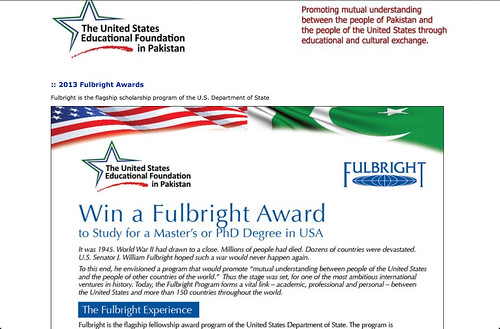
Did you know that Pakistan will have the largest Fulbright program in the world in 2013? The program will award Pakistanis with grants to study for their Master's or Ph.D degrees at a U.S. university beginning in Fall 2013. Deadline is May 16, 2012 to apply.
 © 2014
