Showing posts with label petroleum. Show all posts

Saturday, October 31, 2015

Exxon's Climate Change Cover-Up Is 'Unparalleled Evil,' Says Activist

Exxon Mobil's decision to hide research that confirmed fossil fuels' role in global warming for decades amounts to "unparalleled evil," environmentalist Bill McKibben said.

Bill McKibben

In an op-ed published Wednesday in The Guardian, the activist once called "the nation's leading environmentalist" said the oil giant set back by decades any effective action to curb climate change when it publicly disputed the very facts its research confirmed.

"To understand the treachery -- the sheer, profound, and I think unparalleled evil -- of Exxon, one must remember the timing," he wrote. "Global warming became a public topic in 1988, thanks to Nasa scientist James Hansen -- it’s taken a quarter-century and counting for the world to take effective action."

Over the past three weeks, the results of two independent investigations were published by the Pulitzer-Prize winning website Inside Climate News and the Los Angeles Times.

The evidence was damning.

By 1978, Exxon's senior scientists told management that carbon dioxide emissions from burning fossil fuels warmed the planet, according to the investigations. By 1982, the company's own analysis of climate models found temperatures could rise up to 5 degrees from the "connection between Exxon's major business and the role of fossil fuel combustion in contributing to the increase in atmospheric CO2." By 1991, a senior researcher at the company's Canadian subsidiary said such temperature rises "will clearly affect sea ice, icebergs, permafrost and sea levels."

"If at any point in that journey Exxon -- largest oil company on Earth, most profitable enterprise in human history -- had said: 'Our own research shows that these scientists are right and that we are in a dangerous place,' the faux debate would effectively have ended," McKibben wrote. "That’s all it would have taken; stripped of the cover provided by doubt, humanity would have gotten to work."

Yet, publicly, Exxon funded institutes to cook up reports denying the overwhelming consensus of the scientific community and, as it happens, its own researchers.

"[T]his company had the singular capacity to change the course of world history for the better and instead it changed that course for the infinitely worse," McKibben wrote. "In its greed Exxon helped -- more than any other institution -- to kill our planet."

Exxon did not return a call requesting comment. More


Friday, October 30, 2015

The long-term petroleum price outlook - When will it escalate?

For the last few years, the Saudi kingdom’s insistence on pumping oil at high capacity has dramatically depressed oil prices. The result has undermined Saudi’s major oil rivals in OPEC – like Iran and Venezuela.

It has also hit Russia, hard.

Rating agency Standard & Poor forecasts that Russia’s budget deficit is set to swell to 4.4 per cent of GDP this year. Russia’s own finance ministry concedes that if expenditures continue at this rate, within sixteen months – by around the end of next year – its oil reserve funds will be exhausted.

Meanwhile, over the last year real incomes have dropped by 9.8 per cent, and food prices have spiked by 17 per cent, heightening the risk of civil unrest.

System failureh

Rumbling along beneath the surface of such financial woes are deeper systemic issues.

A report from the Swedish Defence Research Agency notes that “prolonged dry periods in southern Russia are having the effect of reducing the level of food production”.

Most of Russia’s wheat imports come from Kazakhstan, “where climate change is expected to exacerbate droughts. These impacts would make farming harder and food more expensive,” observe Dr. Marina Sharmina and Dr. Christopher Jones of the Tyndall Centre for Climate Change Research.

Russia’s looming energy crisis is the other elephant in the room. In 2013, HSBC forecasted that Russia would hit peak oil between 2018 and 2019, experiencing a brief plateau before declining by 30 per cent from 2020 to 2025.

That year, Fitch Ratings came to pretty much the same conclusion. And last year, Leonid Fedun, vice-president of Russia’s second largest oil producer, Lukoil, predicted that the production could peak earlier due to falling oil prices and US-EU sanctions.

Faced with overlapping economic, food and energy crises, Russia is well and truly on the brink. More

Furthermore, According to a recent report from the IMF, Saudi Arabia’s public debt is estimated to rise from below 2 percent of its GDP in 2014 up to 33 percent by the end of 2020. The report also shows that in the past three years, Saudi Arabia’s budget surplus was turned into a deficit reaching 21.6 percent of GDP in 2015. More


Friday, November 14, 2014

Signs of stress must not be ignored, IEA warns in its new World Energy Outlook

Energy sector must tackle longer-term pressure points before they reach breaking point

Events of the last year have increased many of the long-term uncertainties facing the global energy sector, says the International Energy Agency’s (IEA) World Energy Outlook 2014 (WEO-2014). It warns against the risk that current events distract decision makers from recognising and tackling the longer-term signs of stress that are emerging in the energy system.

In the central scenario of WEO-2014, world primary energy demand is 37% higher in 2040, putting more pressure on the global energy system. But this pressure would be even greater if not for efficiency measures that play a vital role in holding back global demand growth. The scenario shows that world demand for two out of the three fossil fuels – coal and oil – essentially reaches a plateau by 2040, although, for both fuels, this global outcome is a result of very different trends across countries. At the same time, renewable energy technologies gain ground rapidly, helped by falling costs and subsidies (estimated at $120 billion in 2013). By 2040, world energy supply is divided into four almost equal parts: low-carbon sources (nuclear and renewables), oil, natural gas and coal.

In an in-depth focus on nuclear power, WEO-2014 sees installed capacity grow by 60% to 2040 in the central scenario, with the increase concentrated heavily in just four countries (China, India, Korea and Russia). Despite this, the share of nuclear power in the global power mix remains well below its historic peak. Nuclear power plays an important strategic role in enhancing energy security for some countries. It also avoids almost four years’ worth of global energy-related carbon-dioxide (CO2) emissions by 2040. However, nuclear power faces major challenges in competitive markets where there are significant market and regulatory risks, and public acceptance remains a critical issue worldwide. Many countries must also make important decisions regarding the almost 200 nuclear reactors due to be retired by 2040, and how to manage the growing volumes of spent nuclear fuel in the absence of permanent disposal facilities.

“As our global energy system grows and transforms, signs of stress continue to emerge,” said IEA Executive Director Maria van der Hoeven. “But renewables are expected to go from strength to strength, and it is incredible that we can now see a point where they become the world’s number one source of electricity generation.”

The report sees a positive outlook for renewables, as they are expected to account for nearly half of the global increase in power generation to 2040, and overtake coal as the leading source of electricity. Wind power accounts for the largest share of growth in renewables-based generation, followed by hydropower and solar technologies. However, as the share of wind and solar PV in the world’s power mix quadruples, their integration becomes more challenging both from a technical and market perspective.

World oil supply rises to 104 million barrels per day (mb/d) in 2040, but hinges critically on investments in the Middle East. As tight oil output in the United States levels off, and non-OPEC supply falls back in the 2020s, the Middle East becomes the major source of supply growth. Growth in world oil demand slows to a near halt by 2040: demand in many of today’s largest consumers either already being in long-term decline by 2040 (the United States, European Union and Japan) or having essentially reached a plateau (China, Russia and Brazil). China overtakes the United States as the largest oil consumer around 2030 but, as its demand growth slows, India emerges as a key driver of growth, as do sub-Saharan Africa, the Middle East and Southeast Asia.

“A well-supplied oil market in the short-term should not disguise the challenges that lie ahead, as the world is set to rely more heavily on a relatively small number of producing countries,” said IEA Chief Economist Fatih Birol. “The apparent breathing space provided by rising output in the Americas over the next decade provides little reassurance, given the long lead times of new upstream projects.”

Demand for gas is more than 50% higher in 2040, and it is the only fossil fuel still growing significantly at that time. The United States remains the largest global gas producer, although production levels off in the late-2030s as shale gas output starts to recede. East Africa emerges alongside Qatar, Australia, North America and others as an important source of liquefied natural gas (LNG), which is an increasingly important tool for gas security. A key uncertainty for gas outside of North America is whether it can be made available at prices that are low enough to be attractive for consumers and yet high enough to incentivise large investments in supply.

While coal is abundant and its supply relatively secure, its future use is constrained by measures to improve efficiency, tackle local pollution and reduce CO2 emissions. Coal demand is 15% higher in 2040 but growth slows to a near halt in the 2020s. Regional trends vary, with demand reaching a peak in China, dropping by one-third in the United States, but continuing to grow in India.

The global energy system continues to face a major energy poverty crisis. In sub-Saharan Africa (the regional focus of WEO-2014), two out of every three people do not have access to electricity, and this is acting as a severe constraint on economic and social development. Meanwhile, costly fossil-fuel consumption subsidies (estimated at $550 billion in 2013) are often intended to help increase energy access, but fail to help those that need it most and discourage investment in efficiency and renewables.

A critical “sign of stress” is the failure to transform the energy system quickly enough to stem the rise in energy-related CO2 emissions (which grow by one-fifth to 2040) and put the world on a path consistent with a long-term global temperature increase of 2°C. In the central scenario, the entire carbon budget allowed under a 2°C climate trajectory is consumed by 2040, highlighting the need for a comprehensive and ambitious agreement at the COP21 meeting in Paris in 2015.

The World Energy Outlook is for sale at the IEA bookshop. Journalists who would like more information should contact ieapressoffice@iea.org.

Download the following resources:

About the IEA

The International Energy Agency is an autonomous organisation that works to ensure reliable, affordable and clean energy for its 29 member countries and beyond. Founded in response to the 1973/4 oil crisis, the IEA’s initial role was to help countries co-ordinate a collective response to major disruptions in oil supply. While this remains a key aspect of its work, the IEA has evolved and expanded. It is at the heart of global dialogue on energy, providing authoritative research, statistics, analysis and recommendations.

Alternative Download


Wednesday, March 19, 2014

Solar Resource Fundamentals

Figure 1: Comparing finite and renewable planetary energy reserves (Terawatt-years).
Total recoverable reserves are shown for the finite resources. Yearly potential is
shown the environmental for the renewables (source: Perez & Perez, 2009a)


We have, on this planet, vast renewable energy potential: First and foremost, the solar energy resource is very large (Perez et al., 2009a). Figure 1 compares the current annual energy consumption of the world to (1) the known planetary reserves of the finite fossil and nuclear resources, and (2) to the yearly potential of the renewable alternatives. The volume of each sphere represents the total amount of energy recoverable from the finite reserves and the annual potential of renewable sources.

While finite fossil and nuclear resources are very large, particularly coal, they are not infinite and would last at most a few generations. More


Sunday, March 16, 2014

A Fork in the Road by Dr. James Hansen

We stand at a fork in the road. Conventional oil and gas supplies are limited. We can move down the path of dirtier more carbon-intensive unconventional fossil-fuels, digging up the dirtiest tar sands and tar shales, hydrofracking for gas, continued mountain-top removal and mechanized destructive long-wall coal mining. Or we can choose the alternative path of clean energies and energy efficiency.

The climate science is crystal clear. We cannot go down the path of the dirty fuels without guaranteeing that the climate system passes tipping points, leaving our children and grandchildren a situation out of their control, a situation of our making. Unstable ice sheets will lead to continually rising seas and devastation of coastal cities worldwide. A large fraction of Earth's species will be driven to extinction by the combination of shifting climate zones and other stresses. Summer heat waves, scorching droughts, and intense wildfires will become more frequent and extreme. At other times and places, the warmer water bodies and increased evaporation will power stronger storms, heavier rains, greater floods.

The economics is crystal clear. We are all better off if fossil fuels are made to pay their honest costs to society. We must collect a gradually rising fee from fossil fuel companies at the source, the domestic mine or port of entry, distributing the funds to the public on a per capita basis. This approach will provide the business community and entrepreneurs the incentives to develop clean energy and energy-efficient products, and the public will have the resources to make changes.

This approach is transparent, built on conservative principles. Not one dime to the government.

The alternative is to slake fossil fuel addiction, forcing the public to continue to subsidize fossil fuels. And hammer the public with more pollution. The public must pay the medical costs for all pollution effects. The public will pay costs caused by climate change. Fossil fuel moguls get richer, we get poorer. Our children are screwed. Our well-oiled coal-fired government pretends to not understand.

Joe Nocera is polite, but he does not understand basic economics. If a rising price is placed on carbon, the tar sands will be left in the ground where they belong. And the remarkable life and landscape of the original North American people will be preserved.

Joe Nocera quoted a private comment from a note explaining that I could not promise I would be back in New York to meet him. But he did not mention the contents of the e-mail that I sent him with information about the subject we were to discuss. The entire e-mail is copied below.

Jim Hansen


_______

Joe,

Here are some relevant words from the draft of a paper that I am working on:

Transition to a post-fossil fuel world of clean energies will not occur as long as fossil fuels are the cheapest energy. Fossil fuels are cheap only because they are subsidized and do not pay their costs to society. Air and water pollution from fossil fuel extraction and use have high costs in human health, food production, and natural ecosystems, with costs borne by the public. Costs of climate change and ocean acidification also are borne by the public, especially young people and future generations.

Thus the essential underlying policy, albeit not sufficient, is for emissions of CO2 to come with a price that allows these costs to be internalized within the economics of energy use. Because so much energy is used through expensive capital stock, the price should rise in a predictable way to enable people and businesses to efficiently adjust lifestyles and investments to minimize costs.

An economic analysis indicates that a tax beginning at $15/tCO2 and rising $10/tCO2 each year would reduce emissions in the U.S. by 30% within 10 years. Such a reduction is more than 10 times as great as the carbon content of tar sands oil carried by the proposed Keystone XL pipeline (830,000 barrels/day). Reduced oil demand would be nearly six times the pipeline capacity, thus rendering it superfluous

A rising carbon price is the sine qua non for fossil fuel phase out, but it is not sufficient. Investment is needed in energy RD&D (research, development and demonstration) in new technologies such as low-loss smart electric grids, electrical vehicles interacting effectively with the power grid, and energy storage for intermittent renewable energy. Nuclear power has made major contributions to climate change mitigation and mortality prevention, and advanced nuclear reactor designs can address safety, nuclear waste, and weapons proliferation issues that have limited prior use of nuclear power, but governments need to provide a regulatory environment that supports timely construction of approved designs to limit costs. etc.

Jim Hansen


Friday, March 8, 2013

The Deepening Iran-Pakistan Petro-Relationship

The Iran-Pakistan branch of the Iran-Pakistan-India gas pipeline (IPI) seems to be coming online. Pakistani President Asif Ali Zardari has announced he will visit Iran for the groundbreaking of the Pakistan branch of a new gas pipeline on March 11. It will be his second visit to Iran in less than a month, part of a deepening petro-relationship that is worrying the United States.

The pipeline is controversial, to say the least, in the US. The State Department has threatened Pakistan with sanctions for dealing with the regime in Iran, offering a electrification projects to replace any sort of benefit Pakistan would get from the petro-deal.

The challenge facing Islamabad is that it is next door to Iran, while the U.S. is not. In the long-run, it is not in their interest to remain at loggerheads with Tehran even if the U.S. wants them to be. In his press statements, foreign ministry spokesman Moazzam Ahmad Khan has been open about this. “Yes, we know about their concerns but hope our friends, including the US, will understand our economic compulsions,” said Khan.

Iran has already proposed building a new oil refinery near the Pakistani port of Gwadar.

The Pakistan-Iran pipeline is separate from a larger regional project to link India with the natural gas fields of Turkmenistan through Afghanistan and Pakistan (the so-called TAPI pipeline, or Trans-Afghanistan pipeline) . It is a goal that has been lurking in the back rooms of the energy industry since the 1990s: how can one efficiently extract and export the vast energy wealth of the Caspian region without going through Russia or China?

Two decades ago Argentina-based Bridas and Texas-based Unocal were in bitter competition for who would get the Taliban’s permission to build a pipeline across Afghanistan. Bridas came close to signing a deal, but pulled out a year later. Unocal actually brought a Taliban delegation to visit the Texas homes of its executives. Unocal eventually pulled out when the Taliban made unreasonable demands.998, Unocal also pulled out when crashed oil prices combined with international opprobrium over the Taliban’s human rights record and terrorism made the deal too difficult to finalize.

The Asia Development Bank has been pushing TAPI for years, though the insecurity in Afghanistan remains a constant barrier to anything concrete coming to pass.

While TAPI languishes in development hell, Pakistan and Iran have pushed forward with their own pipeline.From Iran’s perspective, anything that gives them an economic connection with the region and is outside the regulatory reach of the U.S. government is a boon. From Pakistan’s perspective, too, the prospect of getting income and energy without U.S. strings attached is deeply attractive. More


Sunday, November 4, 2012

The Dogs of War Are Barking - The Urge to Bomb Iran

It’s the consensus among the pundits: foreign policy doesn’t matter in this presidential election. They point to the ways Republican candidate Mitt Romney has more or less parroted President Barack Obama on just about everything other than military spending and tough talk about another “American century.”

The consensus is wrong. There is an issue that matters: Iran.

Don’t be fooled. It’s not just campaign season braggadocio when Romney claims that he would be far tougher on Iran than the president by threatening “a credible military option.” He certainly is trying to appear tougher and stronger than Obama -- he of the drone wars, the “kill list,” and Bin Laden’s offing -- but it’s no hollow threat.

The Republican nominee has surrounded himself with advisors who are committed to military action and regime change against Iran, the same people who brought us the Global War on Terror and the Iraq War. Along with their colleagues in hawkish think tanks, they have spent years priming the public to believe that Iran has an ongoing nuclear weapons program, making ludicrous claims about “crazy” mullahs nuking Israel and the United States, pooh-poohing diplomacy -- and getting ever shriller each time credible officials and analysts disagree.

Unlike with Iraq in 2002 and 2003, they have it easier today. Then, they and their mentors had to go on a sales roadshow, painting pictures of phantom WMDs to build up support for an invasion. Today, a large majority of Americans already believe that Iran is building nuclear weapons.

President Obama has helped push that snowball up the hill with sanctions toundermine the regime, covert and cyber warfare, and a huge naval presence in the Persian Gulf. Iran has ratcheted up tensions via posturing militarymaneuvers, while we have held joint U.S.-Israeli exercises and "the largest-ever multinational minesweeping exercise" there. Our navies are facing off in a dangerous dance.

Obama has essentially loaded the gun and cocked it. But he has kept his finger off the trigger, pursuing diplomacy with the so-called P5+1 talks andrumored future direct talks with the Iranians. The problem is: Romney’s guyswant to shoot.

Unlike Iraq, Iran Would Be an Easy Sell

Remember those innocent days of 2002 and 2003, when the war in Afghanistan was still new and the Bush administration was trying to sell an invasion of Iraq? I do. I was a Republican then, but I never quite bought the pitch. I never felt the urgency, saw the al-Qaeda connection, or worried about phantom WMDs. It just didn’t feel right. But Iran today? If I were still a Republican hawk, it would be “game on,” and I’d know I was not alone for three reasons.

First, even armchair strategists know that Iran has a lot of oil that is largely closed off to us. It reputedly has the fourth largest reserves on the planet. It also has a long coastline on the Persian Gulf, and it has the ability to shut the Strait of Hormuz, which would pinch off one of the world’s major energy arteries.

Then there is the fact that Iran has a special place in American consciousness. The Islamic Republic of Iran and the mullahs who run it have been a cultural enemy ever since revolutionary students toppled our puppet regime there and stormed the U.S. Embassy in Tehran in 1979.1 The country is a theocracy run by angry-looking men with long beards and funny outfits. It has funded Hezbollah and Hamas. Its crowds call us the “Great Satan.” Its president denies the Holocaust and says stuff about wiping Israel off the map. Talk about a ready-made enemy.

Finally, well, nukes.

The public appears to be primed. A large majority of Americans believe that Iran has an ongoing nuclear weapons program, 71% in 2010 and 84% this March. Some surveys even indicate that a majority of Americans would support military action to stop Iran from developing nukes. More


Note: Iran has apparently been a 'cultrual enemy' of the United States and the United Kingdom since the 19th August 1953.

Mohammad Mosaddegh or Mosaddeq (Persian: مُحَمَد مُصَدِق, IPA: [mohæmˈmæd(-e) mosædˈdeɣ] ( listen)*), also Mossadegh, Mossadeq, Mosadeck, or Musaddiq (16 June 1882 – 5 March 1967), was the democratically appointed [1][2][3] Prime Minister of Iran from 1951 to 1953 when his government was overthrown in a coup d'état orchestrated by the British MI5 and the CIA.

Mohammad Mosaddegh
An author, administrator, lawyer, prominent parliamentarian, he became the prime minister of Iran in 1951. His administration introduced a wide range of progressive social and political reforms such as social security, rent control, and land reforms.[4] His government's most notable policy, however, was the nationalization of the Iranian oil industry, which had been under British control since 1913 through the Anglo-Persian Oil Company (APOC/AIOC) (later British Petroleum or BP).[5]

Mosaddegh was removed from power in a coup on 19 August 1953, organised and carried out by the CIA at the request of the British MI6 which chose Iranian General Fazlollah Zahedi to succeed Mosaddegh.[6]

While the coup is commonly referred to as Operation Ajax[7] after its CIA cryptonym, in Iran it is referred to as the 28 Mordad 1332 coup, after its date on the Iranian calendar.[8] Mosaddegh was imprisoned for three years, then put under house arrest until his death. More


Saturday, July 7, 2012

National Energy Conference 2012

A Two Day National Conference titled “Applications of Nuclear Science and Technology in Pakistan” Organized by South Asian Strategic Stability Institute (SASSI) to be held from 12th-13th July 2012 (Tentative) at Islamabad Serena Hotel.

Concept:

Economic growth and industrialization in a globalized world today is inextricably linked to the continuous availability, access, diversity and modernization of energy resources. Ensuring a secure and safe supply of energy, both from domestic and foreign sources, constitutes a core foreign policy pillar of both emerging and established global powers today.

Energy security establishes a frame work which links the issues regarding energy supplies with foreign and national security policy. This link is all the more relevant and provides the requisite flexibility for a state to manage both the crisis and opportunities in this regard. Placing the formulation of energy policy in security domain comes with the benefit of establishing linkage between economic development and national survival.

Pakistanis facing an acute crisis of energy and consequently adverse economic situation. The energy crisis is effecting cross spectrum dimensions of society and economy. The crisis have resulted in a number of substantive protests, some of them being violent, in the back drop of power shortages, limited availability of transport fuel such as compressed natural gas and petrol and price hikes.

The industrial sector is also struggling to meet its production demands and improving the consumer output required to sustain a minimum level of sustainability. Energy crisis has slowed the industrial output and resultantly the already limited manufacturing base. Moreover, the energy crunch has also put restraint on Pakistan’s economy to compete globally in an era of increasing globalization.

In an environment of bleak global economic outlook in the after math of prevailing financial crisis, the problem is compounded given the lack of competitiveness. The much touted Pakistani narrative of “market access” is exhausted by the fact that the energy crunch has limited Pakistan’s capacity to compete with emerging and established economies. So market access will not bring desired output unless the domestic economic front is strengthened in Pakistan.

There also exists an international dimension to Pakistan’s energy crunch.Pakistanis subjected to international diplomatic and political pressure, by the select few, over its efforts of diversification of its energy imports. The case in point isIran–Pakistangas pipeline (IP). International sanctions on Iran and subsequent diplomatic pressure on Pakistan to be a process of Iranian containment have exacerbated the energy crisis and increased the uncertainty of its economic future. More


Thursday, June 21, 2012

Is Barack Obama Morphing Into Dick Cheney?

Four Ways the President Is Pursuing Cheney’s Geopolitics of Global Energy

As details of his administration’s global war against terrorists, insurgents, and hostile warlords have become more widely known -- a war that involves a mélange of drone attacks, covert operations, and presidentially selected assassinations -- President Obama has been compared to President George W. Bush in his appetite for military action. “As shown through his stepped-up drone campaign,” Aaron David Miller, an advisor to six secretaries of state, wrote at Foreign Policy, “Barack Obama has become George W. Bush on steroids.”

When it comes to international energy politics, however, it is not Bush but his vice president, Dick Cheney, who has been providing the role model for the president. As recent events have demonstrated, Obama’s energy policies globally bear an eerie likeness to Cheney’s, especially in the way he has engaged in the geopolitics of oil as part of an American global struggle for future dominance among the major powers.

More than any of the other top officials of the Bush administration -- many with oil-company backgrounds -- Cheney focused on the role of energy in global power politics. From 1995 to 2000, he served as chairman of the board and chief executive officer of Halliburton, a major supplier of services to the oil industry. Soon after taking office as vice president he was asked by Bush to devise a new national energy strategy that has largely governed U.S. policy ever since.

Early on, Cheney concluded that the global supply of energy was not growing fast enough to satisfy rising world demand, and that securing control over the world’s remaining oil and natural gas supplies would therefore be an essential task for any state seeking to acquire or retain a paramount position globally. He similarly grasped that a nation’s rise to prominence could be thwarted by being denied access to essential energy supplies. As coal was to the architects of the British empire, oil was for Cheney -- a critical resource over which it would sometimes be necessary to go to war. More


Tuesday, March 27, 2012

Increased solar power use in Pakistan

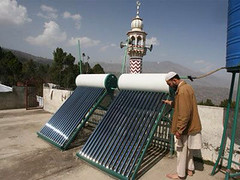
Pakistani teacher Kashif shows solar geysers on the roof of his seminary in Murree. From mosques, to homes to street lights, Pakistanis are increasingly seeing the light and realising that year-round sun may be a quick and cheap answer to an enormous energy crisis.


Pakistan needs to produce 16,000 megawatts of electricity to cater for daily demand, but falls short by providing only 13,000 megawatts, according to the state-owned Pakistan Electric Power Company. More

Pakistan would be very smart if the encouraged investment in Alternative Energy (AE) now for a number of reasons. The most obvious being the shortage of electricity and the second and perhpas more important being the fact that oil prices are going to keep escalating making it more difficult for Pakistani's to afford electricity in the future. Editor.