Pakistan's growing need for Energy: options of coal, gas & nuclear energy and renewables by Dr Maria Sultan, Director General, South Asian Strategic Stability Institute, Pakistan. Published on Dec 19, 2014
Pakistan's growing need for Energy: options of coal, gas & nuclear energy and renewables by Dr Maria Sultan, Director General, South Asian Strategic Stability Institute, Pakistan. Published on Dec 19, 2014


Last week Pakistan’s Prime Minister Nawaz Sharif inaugurated Pakistan’s first solar power park, which will start generating 100 megawatts of energy by the end of the year and a total of 1,000 megawatts by 2016.
 |
| Solar Farm in Bahawalpur, Pakistan |
The Quaid-e-Azam Solar Park project has 400,000 solar panels, with a total cost of around $131 million. When complete the plant will produce about 2.5 times the power coming from the 392 megawatt Ivanpah solar thermal plant in California’s Mojave Desert, making it one of the largest solar parks in the world.
“If you come here after one and a half years, you will see a river of solar panels, residential buildings and offices — it will be a new world,” said site engineer Muhammad Sajid, pointing towards the surrounding desert.
This is big news for a country suffering from chronic energy shortages that leave people without power for large chunks of the day on a regular basis. And then there’s the nearly half of the households that aren’t even connected to the grid,according to a World Bank study. When temperatures soar in the summer, electricity demand can fall short by around 4,000 megawatts.
At the inauguration, the prime minister said “the dearth of electricity has pushed the country backwards and its entire industry and agriculture sector have suffered immensely.”
Pakistan is one of the most vulnerable countries in the world to the impacts of climate change due to its location, population, and environmental degradation. A recent study in the journal Nature Climate Change found that people are already migrating out of the Pakistan for climate-related reasons such as flooding and heat stress, which have negative effects on agriculture and can prove very costly.
“We need energy badly and we need clean energy, this is a sustainable solution for years to come,” Imran Sikandar Baluch, head of the Bahawalpur district administration in Punjab where the plant is located, told the AFP. “Pakistan is a place where you have a lot of solar potential. In Bahawalpur, with very little rain and a lot of sunshine, it makes the project feasible and more economical.”
At a meeting shortly after the inauguration, Sharif approved expanding the project from from 10,000 acres to 15,000 acres and increasing the capacity from 1,000 megawatts to 1,500 megawatts. More
Solar energy experts have long known that the best place to collect the sun's rays is in space. A solar farm in orbit could collect energy all the time, whereas ground-based arrays sit idle during the night.

And huge chunks of real estate are easier to come by in space, where solar collectors can be as enormous as they need to be. But the problems with turning solar energy in space into useable energy on Earth have kept space solar stuck in the land of science fiction since the 1960s.
Yet Japan's version of NASA, the Japan Aerospace Exploration Agency, is optimistic. JAXA recently unveiled a technology roadmap that says it can make solar arrays in orbit a reality by the 2030s, and that plant could supply 1 gigawatt of energy, the equivalent of one of the country's nuclear plants. Susumu Sasaki reports for IEEE Spectrum.
Microwaves are key to JAXA's plans. Some space solar concepts have proposed using lasers to beam the energy in orbit down to collectors on the surface, but the water molecules in the clouds can scatter laser light. That means you'd lose some of the energy on anything less than a perfectly clear day. Microwaves don't have that problem. So JAXA has designed multiple concepts in which the DC (direct current) power generated in orbit would be transformed into microwaves and then beamed to Earth's surface, where a farm of antennas would collect the microwaves and transform them back into DC electricity. JAXA says it can now perform these transformations with at least 80 percent efficiency on each end.
Another major hurdle for space solar is keeping the collectors pointed at the sun at all times so they can collect energy continuously. JAXA released one design that features a square panel measuring 2 kilometers (1.2 miles) on each side. But the panel's orientation is fixed, meaning the amount of energy it can produce varies. Another JAXA design solves this problem by incorporating two enormous mirrors that reflect sunlight onto photovoltaic panels positioned between them.
More hurdles: If a space solar array had to burn fuel to adjust its position, for example, that would add millions of dollars to the cost. So Japan is trying to design its components in such a way that they naturally counterbalance Earth's gravity and stay in position without adjustment. In the case of the two-mirror design, all those pieces would need to fly in careful, precise formation, something that has not been tried on so grand a scale.
In the transmission phase, more than a billion tiny antennas affixed to moveable panels would be required to receive the microwave energy coming from space. Those panels must constantly adjust their orientation to maximize how much energy they receive. JAXA plans to help them by sending a pilot signal from the ground to the satellite that would tell the satellite how to adjust the beam.
Despite these and more challenges, JAXA has rolled out an ambitious timeline: It plans to unveil a ground-based demonstration this year, then reveal progressively larger experimental satellites in 2017, 2021, and 2024. The major goal would come to fruition in the following decade: A 1-GW power station in 2031, and then one power station launched per year by the late 2030s.
Within a quarter-century, then, perhaps Japan's energy will come not from nuclear plants -- which are vulnerable to earthquakes, tsunamis, and planetary outbursts -- but from solar arrays that aren't even on the planet. More
 |
| Figure 1: Comparing finite and renewable planetary energy reserves (Terawatt-years). Total recoverable reserves are shown for the finite resources. Yearly potential is shown the environmental for the renewables (source: Perez & Perez, 2009a) |
We have, on this planet, vast renewable energy potential: First and foremost, the solar energy resource is very large (Perez et al., 2009a). Figure 1 compares the current annual energy consumption of the world to (1) the known planetary reserves of the finite fossil and nuclear resources, and (2) to the yearly potential of the renewable alternatives. The volume of each sphere represents the total amount of energy recoverable from the finite reserves and the annual potential of renewable sources.
While finite fossil and nuclear resources are very large, particularly coal, they are not infinite and would last at most a few generations. More
Webinar: Opportunities and Challenges for Rural Off-Grid Lighting and Distribution Markets in India

The United Nations Foundation's Energy Access Practitioner Network, in partnership with the Clean Energy Solutions Center, is hosting a no-cost, webinar-based training about the challenges and opportunities within India's rural off-grid lighting and distribution markets. Panelists will discuss energy access initiatives being undertaken in India by the UN Foundation as part of the UN and World Bank's Sustainable Energy for All initiative.
Anjali Garg and Praveen Kumar will provide an overview of the IFC's Lighting Asia/India program and discuss the work being undertaken to effectively address the energy needs of communities in remote rural areas, while promoting local entrepreneurship and sustainable rural development.
Ajaita Shah from Frontier Markets will share her experience working with remote rural communities in Rajasthan, India, to provide access to affordable and quality solar solutions to low-income households.
Gaurav Gupta from Dalberg will talk about emerging and innovative distribution models in off-grid renewable energy sectors in India.
The presentations will be followed by an interactive Q&A session that will allow participants to discuss best practices in the lighting and distribution markets in India and whether this work can be scaled and applied to other markets.
To register, please visit https://www3.gotomeeting.com/register/313205262.
Author bios can be found at https://cleanenergysolutions.org/training/rural-off-grid-lighting-distribution-markets-india.
Two of the largest oil producers are readying the Middle East's first big push into renewable energy, planning solar-power plants that will need more than $1.5 billion in financing by the end of 2014.

Saudi Arabia, the biggest member of the Organization of Petroleum Exporting Countries, and the United Arab Emirates, fourth-biggest in the group, are seeking to add 1,000 megawatts of solar capacity, enough to electrify 200,000 homes. The forecast expansion, which includes Jordan, will require loans and export credits, said Vahid Fotuhi, president of the Dubai-based Emirates Solar Industry Association.
Governments across the Middle East and North Africa consider sun and wind energy as crucial for meeting the needs of growing populations and economies, with Saudi Arabia leading the way. Oil-producers want to develop renewables to conserve more crude for export, while countries relying on imported fuel see local green power as a cheaper alternative.
State support for utilities and a growth in regional power demand of about 5 percent a year mean companies such as Abu Dhabi National Energy Co. (TAQA) can borrow at rates that are 100 basis points, or 1 percentage point, lower than Spain's Abengoa Solar SA.
Risk Profile
"If you see a rising population and rising energy demand, that really helps the risk profile," Amol Shitole, a credit analyst with SJS Markets Ltd. in Bangalore, India, said by telephone July 25. Projects that can pair local companies with international power-plant developers already known to lenders will have "strong support from banks," he said.
Renewables investment in the Middle East and North Africa rose 40 percent last year to $2.9 billion, according to the International Renewable Energy Agency. Spending on more than 100 projects under development, including those for solar, wind and geothermal power, could surge to about $13 billion in a few years, Abu Dhabi-based IRENA said yesterday in a report released jointly with U.A.E. government and a research group called the Renewable Energy Policy Network.
Saudi Arabia, the world's largest oil exporter, plans to invest more than $100 billion to generate about 41,000 megawatts from solar energy, or a third of its total power output, by 2032. That compares with about 16 megawatts of solar capacity today, a level that places the kingdom behind Egypt, Morocco, Algeria and the U.A.E., according to Bloomberg New Energy Finance.
Revolving Credits
Abu Dhabi National Energy, a conventional energy-producer known as Taqa, raised about $4 billion in loans this year and in 2012. The $2.5 billion in revolving credits it arranged in December include a three-year credit priced at 75 basis points more than the London interbank offered rate, and a five-year component priced at 100 basis points more than the Libor benchmark, data compiled by Bloomberg show.
Abengoa Solar, a partner in an Abu Dhabi sun-power plant, borrowed $142 million at 175 basis points more than Libor, according to data compiled by Bloomberg. Costs are even higher for First Solar Inc. (FSLR), the largest U.S. solar manufacturer and builder of Dubai's first solar electricity plant, which arranged a $431 million secured letter of credit at 225 basis points more than Libor, data gathered by Bloomberg show.
Backing from the Abu Dhabi government helped Taqa achieve an A rating, the sixth-highest investment grade, at Standard and Poor's. Abengoa SA (ABG), Abengoa Solar's Spanish parent, is rated B, six levels below investment grade. First Solar isn't rated. 'Green Sukuk'
"Bank loans will be the way to go for financing," rather than bond sales, said Shitole of SJS. Startup renewables projects would borrow more cheaply using loans and could issue bonds later to refinance their bank debt once the plants are earning steady income necessary to make regular interest payments, he said.
Lenders may hesitate to continue funding the massive expansion foreseen by Saudi Arabia as commercial banks seek to limit exposure to renewables projects, said Steve Mercieca, the Dubai-based chief executive officer of the Clean Energy Business Council. Governments should encourage the availability of Islamic bonds, or green sukuk, to help finance solar facilities under construction, he said.
"The Saudi market already has an attractive framework for building and funding traditional power plants, and liquidity is ample in local banks," Mercieca said. "Appetite is going to be substantial" for the funding of such projects, he said. Masdar Project
Taqa and its partners in the Ruwais Power Co. last week became the region's second company to sell a project bond, with repayment of interest linked to the utility's profit. The S2 power plant raised $825 million in bonds due in 2036 at a 6 percent margin, improving on the 6.2 percent margin on $1.5 billion of bonds Bahrain's government sold last week.
Masdar, Abu Dhabi's government-owned renewable energy company, opened the $750 million, 100 megawatt Shams 1 solar power plant, the region's largest, in March. Together with partners Abengoa Solar and French oil producer Total SA (FP), it borrowed a $612 million secured loan in March 2011, without disclosing terms on the debt that matures in 2033. More

Climate Change and the Energy Challenge: Towards an Energy Efficient and Renewable-based System-
An interdisciplinary approach to today’s great energy questions - 10th annual Summer Academy 'Energy and the Environment' | September 15-21 | BrusselsOrganised by IKEM and the University of GreifswaldThe Summer Academy is looking for academics and professionals working in the field of climate change and sustainable energy, to join and together address the state, technology, economics, efficiency, RES, policy and legal aspects of a transition to a sustainable system during one week of lectures, seminars and workshops. Exceptionally held in Brussels from 15-21 September, after local summer holidays, the 10th annual Summer Academy ‘Energy and the Environment’ will revisit the major climate and energy questions of our generation, questions that have driven the event since its very first edition in 2004. Paying special attention to the demand and supply-side potential and challenges of energy efficiency, the 10th anniversary of the Summer Academy ‘Energy and the Environment’ looks back on the major topics addressed over the past decade, to evaluate what progress has been made and to weave new issues and recent (technological) developments into the discussion.
Topic Climate Change and the Energy Challenge: Towards an Energy Efficient and Renewable-based System As climate change is forcing us to redesign our energy system and consumption patterns, energy efficiency and renewable energy feature high on the agenda of policy-makers and businesses alike. Energy efficiency measures are rapidly integrated across the economy, and fossil fuel is making way for renewables. But are current efforts enough to mitigate climate change? The Academy will kick off with an in-depth study on the state of climate change, climate policy and the continuing dominance of conventional fuels (including new sources like shale gas and tar sand) in today’s energy infrastructure and matrix (Monday and Tuesday). This diagnosis is the foundation on which the program will develop a comprehensive, interdisciplinary analysis of energy efficiency and renewable energy sources, the building blocks of decarbonization strategies worldwide (Wednesday-Friday).
Benefits The event is a strong international networking platform for legal experts and young professionals working in the field of (sustainable) energy and climate policy. Delegates will benefit from insights into the energy market’s latest developments and gain access to a strong network of professional contacts through the teaching faculty and fellow participants. The challenges addressed by climate policy and energy law are the result of complex interactions and developments of economics, the legal, environmental and sociological field. These must continuously feed-into and inform new legal and policy initiatives. Based on this principle, the Academy offers a diverse agenda and matching teaching faculty, including representatives from the academic world, think-tanks, energy business and of course the legal field. Past faculty and participants include representatives from the German Federal Environment Agency, the Department for Energy and Climate change, businesses like TenneT, Siemens, DONG energy and First Solar, DECC, (UK), legal practitioners from Germany’s leading energy law firm Becker Büttner Held, think-tanks like Ecologic, Juwi R&D, and Ecofys and academia from all over the world, including the University of Oxford, Amsterdam, Sejong and Berkeley (for a more extensive overview, please see ikemsummeracademy.de/faculty). The Academy has weaved a comprehensive network of contacts that have proven to be a valuable source of information long after the event, indeed, most participants still use their network today!
The location 2013 is a special year for the Summer Academy: It marks the 10-year anniversary of this international event! At this occasion, the Academy will be hosted in Brussels, at the Representation of the Bundesland Mecklenburg Vorpommern to Brussels from Monday to Thursday. On Friday, the final conference will be hosted by the Academy’s long-time partner, German energy law firm Becker Büttner Held, at their Brussels office.
Participants The Academy is looking for participants who work or study in the field of energy and the environment, who like to actively participate in discussion and possibly present their work during the Academy. All participants may submit an article for publication on their particular work or focus in the field, which will be published by the Berlin-based legal publisher Lexxion.
Join! We would love to hear from you if you are interested in participating in the Summer Academy. You can download an application form at ikemsummeracademy.de/applications and send it to summeracademy2013@ikem-online.de by the 20th of June. To find out more about the event, its history, past publications and events you can check out our website at: ikemsummeracademy.deWe look forward to hearing from you!Kind regards,
Prof. Michael Rodi University of Greifswald Director of IKEM
Anika Nicolaas Ponder Events and publications | Organisation of the IKEM Summer AcademySummeracademy2013@ikem-online.de Magazinstraße 15-16 | D-10179 | Berlin | GermanyTel. + 49 (0) 30 408 187 015Fax + 49 (0) 30 408 187 029 www.ikem-online.de

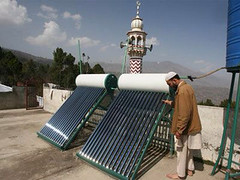
Pakistani teacher Kashif shows solar geysers on the roof of his seminary in Murree. From mosques, to homes to street lights, Pakistanis are increasingly seeing the light and realising that year-round sun may be a quick and cheap answer to an enormous energy crisis.
Pakistan needs to produce 16,000 megawatts of electricity to cater for daily demand, but falls short by providing only 13,000 megawatts, according to the state-owned Pakistan Electric Power Company. More
Pakistan would be very smart if the encouraged investment in Alternative Energy (AE) now for a number of reasons. The most obvious being the shortage of electricity and the second and perhpas more important being the fact that oil prices are going to keep escalating making it more difficult for Pakistani's to afford electricity in the future. Editor.

 © 2014