Wednesday, August 8, 2012

When philosophers join the kill chain

Scholars have always loved war, whether it's chemists and engineers discovering more efficient ways to kill large numbers of people or social scientists, theologians and philosophers debating when, why and how to fight. Philosophers in particular have long thought about violence; Plato was likely not the first thinker to understand that what goes by the name of "justice" is often merely the violence and thievery practiced by those holding the reins of power. For Plato, their ability to continue to rule depended on imposing upon the weak the very rules they routinely break to maintain their position.

Plato argued that a well-functioning society could exist only in so far as philosophers and warriors were its "guardians" (the latter under the former's watchful gaze). To ensure justice prevailed under this system, the guardians would live in poverty and share all their possessions in common, even their children.

Sadly - at least for some philosophers - society hasn't progressed in quite the way Plato had hoped.

War, drones and justice

Most philosophers today accept the argument by the seminal inter-war philosopher Walter Benjamin that violence cannot be understood or judged except "in its relation to law and justice". Arguments about whether a war or the means with which it's fought are "just" in the past century have been increasingly grounded in international law, particularly international humanitarian law and the imperative of protecting civilians who are inevitably caught in the crossfire of conflicts, whether civil or international.

While there are certainly many conservative philosophers who write prolifically in support of their definitions of "just war" (the philosophical underpinnings of President Bush's idea of "preemptive war" is among the most recent examples of thisoeuvre), the profession as a whole can be said to skew towards a more anti-war sentiment. This view is epitomised by a 2003 statement released by members of the American Philosophical Association against the US invasion of Iraq. It argued that launching a preemptive war without the threat of an imminent attack "stretches the meaning of preemption beyond reasonable bounds and sets a dangerous precedent which other states may feel free to follow".


Today, the most vehement debates surrounding the use of force by the United States no longer surround the invasion and occupation of Iraq, but rather the use of remotely piloted aerial vehicles - more commonly known as "drones" - by the US, as one of the most important weapons in its ongoing war on terror. The use of drones has caused an uproar not just in countries such as Pakistan, Afghanistan, Yemen and the occupied territories, where they are routinely used to kill suspected militants, but also among ethicists and the international legal community.

And now, at least one philosopher, Bradley Jay Strawser, has taken up the challenge of offering a viable justification for the use of drones. A recent hire at the Naval Postgraduate School, his arguments have caused enough of a stir to warrant a profile and opinion piece in the Guardian. Strawser now claims that the Guardian profile in fact misrepresented some of his views; but after reading two of his published papers on the subject, the profile in fact underplays the glaring problems in his arguments. When applied to US policy more broadly, they reveal just how far into a moral and ethical quagmire the United States has sunk under the Bush and Obama administrations. More


The Economic Cost of Increased Temperatures: Warming Episodes Hurt Poor Countries and Limit Long-Term Growth

ScienceDaily (Aug. 7, 2012) — Even temporary rises in local temperatures significantly damage long-term economic growth in the world's developing nations, according to a new study co-authored by an MIT economist.

Looking at weather data over the last half-century, the study finds that every 1-degree-Celsius increase in a poor country, over the course of a given year, reduces its economic growth by about 1.3 percentage points. However, this only applies to the world's developing nations; wealthier countries do not appear to be affected by the variations in temperature.

"Higher temperatures lead to substantially lower economic growth in poor countries," says Ben Olken, a professor of economics at MIT, who helped conduct the research. And while it's relatively straightforward to see how droughts and hot weather might hurt agriculture, the study indicates that hot spells have much wider economic effects.

"What we're suggesting is that it's much broader than [agriculture]," Olken adds. "It affects investment, political stability and industrial output."

Varied effects on economies

The paper, "Temperature Shocks and Economic Growth: Evidence from the Last Half Century," was published this summer in the American Economic Journal: Macroeconomics. Along with Olken, the authors are Melissa Dell PhD '12, of Harvard University, who was a PhD candidate in MIT's Department of Economics when the paper was produced, and Ben Jones PhD '03, an economist at Northwestern University.

The study first gained public attention as a working paper in 2008. It collects temperature and economic-output data for each country in the world, in every year from 1950 through 2003, and analyzes the relationship between them. "We couldn't believe no one had done it before, but we weren't really sure we'd find anything at all," Olken says.

By looking at economic data by type of activity, not just aggregate output, the researchers concluded there are a variety of "channels" through which weather shocks hurt economic production -- by slowing down workers, commerce, and perhaps even capital investment.

"If you think about people working in factories on a 105-degree day with no air conditioning, you can see how it makes a difference," Olken says.

One consequence of this, borne out in the data, is that the higher temperatures in a given year affect not only a country's economic activity at the time, but its growth prospects far into the future; by the numbers, growth lagged following hot years. More


Tuesday, August 7, 2012

Climate change is wild card in water security – SEI analysts

We can think creatively about water management, but unknown large global threats could cause a fundamental reorganisation of life on Earth, according to a water expert with the Stockholm Environment Institute (SEI).

“A doomsday scenario would be that if the Greenland ice sheet melts, and then there’s six metres of sea-level rise — all bets are off,” said David Purkey, a senior scientist who heads SEI’s Northern California office. “I think we’ve got bigger problems than water scarcity at that moment.”

“What happens when L.A. has to evacuate, when New York has to evacuate? At that point, I wonder whether rational conversations about water management will be what we’re having.”

In a separate interview, Arno Rosemarin, senior research fellow at SEI’s EcoSanRes (ecological sanitation research) programme, told AlertNet that water security problems will be compounded by global population growth, expected to hit 9 billion by 2050.

Rosemarin cautioned that climate change could also have an unknown impact on vulnerable urban populations in ever-expanding cities.

“We aren’t going to have enough water,” Rosemarin said. When you add factors like weather changes, drought and flooding — you can’t manage — it’s like a monster and that’s not water supply that’s a disaster.”

Treating greywater and sewage to be re-used in urban agriculture — using less water, more efficient taps and appliances — even choosing to eat fried food instead of boiled, are just a few water-management tactics Rosemarin recommends.

To read the interviews, please visit AlertNet, and for more stories about water, visit the Battle for Water page.

Picture caption: Chinese People’s Liberation Army soldiers place sandbags to block a breaching dyke after heavy rainfalls hit the Fangshan district of Beijing, July 25, 2012. REUTERS/Stringer


Saturday, August 4, 2012

In Hiroshima's Shadow - Noam Chomsky

August 6, the anniversary of Hiroshima, should be a day of somber reflection, not only on the terrible events of that day in 1945, but also on what they revealed: that humans, in their dedicated quest to extend their capacities for destruction, had finally found a way to approach the ultimate limit.

This year‚ Aug. 6 memorials have special significance. They take place shortly before the 50th anniversary of, "the most dangerous moment in human history," in the words of the historian and John F. Kennedy adviser Arthur M. Schlesinger Jr., referring to the Cuban missile crisis.

Graham Allison writes in the current issue of Foreign Affairs that Kennedy, "ordered actions that he knew would increase the risk not only of conventional war but also nuclear war," with a likelihood of perhaps 50 percent, he believed, an estimate that Allison regards as realistic.

Kennedy declared a high-level nuclear alert that authorized, "NATO aircraft with Turkish pilots ... (or others) ... to take off, fly to Moscow, and drop a bomb."

None were more shocked by the discovery of missiles in Cuba than the men in charge of the similar missiles that the U.S. had secretly deployed in Okinawa six months earlier, surely aimed at China, at a moment of elevated regional tensions.

Kennedy took Chairman Nikita Khrushchev, "right to the brink of nuclear war and he looked over the edge and had no stomach for it," according to Gen. David Burchinal, then a high-ranking official in the Pentagon planning staff. One can hardly count on such sanity forever.

Khrushchev accepted a formula that Kennedy devised, ending the crisis just short of war. The formula‚ boldest element, Allison writes, was, "a secret sweetener that promised the withdrawal of U.S. missiles from Turkey within six months after the crisis was resolved." These were obsolete missiles that were being replaced by far more lethal, and invulnerable, Polaris submarines.

In brief, even at high risk of war of unimaginable destruction, it was felt necessary to reinforce the principle that U.S. has the unilateral right to deploy nuclear missiles anywhere, some aimed at China or at the borders of Russia, which had previously placed no missiles outside the USSR. Justifications of course have been offered, but I do not think they withstand analysis.

An accompanying principle is that Cuba had no right to have missiles for defense against what appeared to be an imminent U.S. invasion. The plans for Kennedy‚ terrorist programs, Operation Mongoose, called for, "open revolt and overthrow of the Communist regime," in October 1962, the month of the missile crisis, recognizing that, "final success will require decisive U.S. military intervention."

The terrorist operations against Cuba are commonly dismissed by U.S. commentators as insignificant CIA shenanigans. The victims, not surprisingly, see matters rather differently. We can at last hear their voices in Keith Bolender‚, "Voices from the Other Side: An Oral History of Terrorism Against Cuba." More


We Are the Patriots by Gore Vidal

The following essay appeared in the June 2, 2003 edition of The Nation magazine, and we reprint it today following news that Gore Vidal died on July 30 at the age of 86.

Gore Vidal
I belong to a minority that is now one of the smallest in the country and, with every day, grows smaller. I am a veteran of World War II. And I can recall thinking, when I got out of the Army in 1946, Well, that's that. We won. And those who come after us will never need do this again. Then came the two mad wars of imperial vanity--Korea and Vietnam. They were bitter for us, not to mention for the so-called enemy. Next we were enrolled in a perpetual war against what seemed to be the enemy-of-the-month club. This war kept major revenues going to military procurement and secret police, while withholding money from us, the taxpayers, with our petty concerns for life, liberty and the pursuit of happiness.

But no matter how corrupt our system became over the last century--and I lived through three-quarters of it--we still held on to the Constitution and, above all, to the Bill of Rights. No matter how bad things got, I never once believed that I would see a great part of the nation--of we the people, unconsulted and unrepresented in a matter of war and peace--demonstrating in such numbers against an arbitrary and secret government, preparing and conducting wars for us, or at least for an army recruited from the unemployed to fight in. Sensibly, they now leave much of the fighting to the uneducated, to the excluded.

During Vietnam Bush fled to the Texas Air National Guard. Cheney, when asked why he avoided service in Vietnam, replied, "I had other priorities." Well, so did 12 million of us sixty years ago. Priorities that 290,000 were never able to fulfill.

So who's to blame? Us? Them? Well, we can safely blame certain oil and gas hustlers who have effectively hijacked the government from presidency to Congress to, most ominously, the judiciary. How did they do it? Curiously, the means have always been there. It took the higher greed and other interests to make this coup d'état work.

It was Benjamin Franklin, of all people, who saw our future most clearly back in 1787, when, as a delegate to the Constitutional Convention at Philadelphia, he read for the first time the proposed Constitution. He was old; he was dying; he was not well enough to speak but he had prepared a text that a friend read. It is so dark a statement that most school history books omit his key words. More


Friday, August 3, 2012

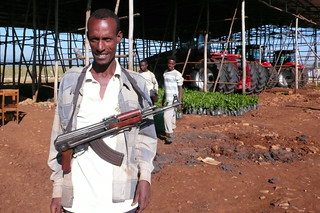
The Global Land Rush: Catalyst For Resource Driven Conflict

On May 11, the UN approved new international rules to govern how land is acquired abroad. These Voluntary Guidelines (VGs), the outcome of several years of protracted negotiations, are a response to growing global concern that nations and private investors are seizing large swaths of overseas agricultural land owned or used by small farmers and local communities for food, medicinal, or livelihood purposes. FAO head Jose Graziano da Silva describes the VGs as “a starting point that will help improve the often dire situation of the hungry and poor.”

It’s hard to quibble with the intent of the guidelines. They call for, among other things, protecting the land rights of local communities; promoting gender equality in land title acquisition; and offering legal assistance during land disputes.

Unfortunately, however, any utility deriving from the VGs will be strictly normative. As their name states explicitly, they are purely optional. A toothless set of non-obligatory rules will prove no match for a strategy that is striking both for its scale and for the tremendous power of its executioners.

Oxfam estimates that nearly 230 million hectares of land (an area equivalent to the size of Western Europe) have been sold or leased since 2001 (with most of these transactions occurring since 2008). According to GRAIN, a global land rights NGO, more than 2 million hectares were subjected to transactions during the first four months of 2012 alone. One of the largest proposed deals—an attempt by South Korea’s Daewoo corporation to acquire 1.3 million hectares of farmland in Madagascar—failed back in 2009. Still, even larger investments are being planned today, including a Brazilian effort to acquire a whopping 6 million hectares of land in Mozambique to produce corn and soy (Mozambique offered a concession last year).

The Brazil-Mozambique deal illustrates another striking element of scale: transactions are not limited to wealthy, developed nations preying on the developing world. Developing nations in Africa, Latin America, and Africa are acquiring farmland as well, and developed countries like New Zealand are some of the targets. Nevertheless, capital-rich countries in East Asia and the Gulf (along with large western corporations and agribusiness firms) are indeed spearheading the majority of the investments, with most of the land located in impoverished African states.

Who are these investors? They include the likes of China and Saudi Arabia, along with companies such as Goldman Sachs. According to the Oakland Institute, prestigious universities such as Harvard and Vanderbilt are joining the farmland craze as well. These wealthy nations and institutions are acquiring land in corruption-prone African countries—such as Sudan, Ethiopia, Kenya—and in areas populated by the rural destitute. More


July 2012 update – US covert actions in Pakistan, Yemen and Somalia

The Bureau’s covert war investigation tracks drone strikes and other US military and paramilitary actions in Yemen, Somalia and Pakistan. Here we summarise our key work and findings for July 2012.

Pakistan: CIA drones kill more people in July than any month so far this year after Pakistanreopens its border to Nato supply convoys.

Yemen: The US restarts Yemen’s $112m [£72m] military aid programme as al Qaeda appears to return to more familiar terror tactics.

Somalia: Three al Shabaab militants are executed for ‘spying’ for western agencies, as the UN claims that more than 60 unknown air sorties took place over Somalia in the past year.

Pakistan

July 2012 actions

Total CIA strikes in July: 4
Total killed in strikes in July: 38-53, of whom 0-20 were reportedly civilians


All actions 2004 – 2012


Total Obama strikes: 285
Total US strikes since 2004: 337
Total reported killed: 2,524-3,247
Civilians reported killed: 482-852
Children reported killed: 175
Total reported injured: 1,204-1,330
For the Bureau’s full Pakistan databases click here.


The CIA launched four drone strikes in July, two fewer than in June. An average of four strikes a month so far this year contrasts with over six a month in 2011 and nearly 11 a month in 2010.

After Hillary Clinton apologised to Pakistan for accidentally killing Pakistani soldiers in a US strike on November 2011, Islamabad lifted its border blockade of NATO supply trucks. Three days later US drones killed 17-24 people in Datta Khel, North Waziristan. Other strikes took place on July 1 and 23. More