Tuesday, July 24, 2012

The world is closer to a food crisis than most people realise

Unless we move quickly to adopt new population, energy, and water policies, the goal of eradicating hunger will remain just that.

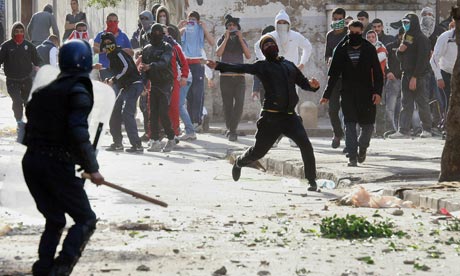
Food riots in Algeria in 2008. Photograph: Fayez Nureldine/AFP/Getty Images
In the early spring this year, US farmers were on their way to planting some 96m acres in corn, the most in 75 years. A warm early spring got the crop off to a great start. Analysts were predicting the largest corn harvest on record.

The United States is the leading producer and exporter of corn, the world's feedgrain. At home, corn accounts for four-fifths of the US grain harvest. Internationally, the US corn crop exceeds China's rice and wheat harvests combined. Among the big three grains – corn, wheat, and rice – corn is now the leader, with production well above that of wheat and nearly double that of rice.

The corn plant is as sensitive as it is productive. Thirsty and fast-growing, it is vulnerable to both extreme heat and drought. At elevated temperatures, the corn plant, which is normally so productive, goes into thermal shock.

Time is running out. The world may be much closer to an unmanageable food shortage – replete with soaring food prices, spreading food unrest, and ultimately political instability– than most people realise.

As spring turned into summer, the thermometer began to rise across the corn belt. In St Louis, Missouri, in the southern corn belt, the temperature in late June and early July climbed to 100F or higher 10 days in a row. For the past several weeks, the corn belt has been blanketed with dehydrating heat.

Weekly drought maps published by the University of Nebraska show the drought-stricken area spreading across more and more of the country until, by mid-July, it engulfed virtually the entire corn belt. Soil moisture readings in the corn belt are now among the lowest ever recorded.

While temperature, rainfall, and drought serve as indirect indicators of crop growing conditions, each week the US Department of Agriculture releases a report on the actual state of the corn crop. This year the early reports were promising. On 21 May, 77% of the US corn crop was rated as good to excellent. The following week the share of the crop in this category dropped to 72%. Over the next eight weeks, it dropped to 26%, one of the lowest ratings on record. The other 74% is rated very poor to fair. And the crop is still deteriorating.

Over a span of weeks, we have seen how the more extreme weather events that come with climate change can affect food security. Since the beginning of June, corn prices have increased by nearly one half, reaching an all-time high on 19 July. More


Monday, July 23, 2012

Erratic Weather Across Globe Fueling Impending Food Crisis

In addition to the ongoing drought in the United States, experts warn that the potential for a worldwide food crisis is heightened by extreme and erratic weather across the globe.

A report in The Guardian cites recent flooding in Russia, an encroaching drought in South America, and heavy rains in the UK and says all contribute to a worldwide arithmetic that adds up to an agricultural nightmare.

The report says that deteriorating conditions are leading more and more analysts to draw parallels to events that led up to the 2008 global food crisis "when high food prices sparked a wave of riots in 30 countries across the world, from Haiti to Bangladesh."

Nick Higgins, a commodity analyst at Rabobank, is quoted as saying: "Food riots are a real risk at this point. Wheat prices aren't up at the level they got to in 2008 but they are still very high and that will have an effect on those who are least able to pay higher prices for food."

And Ruth Kelly, Oxfam's food policy advise, says that popular fury in less developed nations stems from the fact that people in poorer nation's spend a much larger percentage of their income on food than those in wealthier nations.

Kelly told The Guardian problems will be compounded by the previous two food price spikes in 2008 and 2011:

"People are already in debt from previous spikes and suffering the consequences. When the first food crisis hit people were forced to sell off their assets, their cattle and jewellery, and take on debt to make ends meet. After multiple crises, people run out of savings and that can be quite disastrous."

Raj Patel, expert on the global food system and author of the book Stuffed and Starved: Markets, Power and the Hidden Battle for the World’s Food System Writing, recently wrote on his website, "Changing the food system couldn’t be more urgent. All signs point to that conclusion, whether you consider the droughts, floods and fires caused by climate change, the rise in global food prices, or that the health effects of our current food system is predicted to shorten children’s lives."

"Better, and smarter ways of growing food, and feeding the world are needed, now," Patel said. More


Energy & Water are Closely Related

While we are always reminded in the media about the questions of energy security, water resources are equally important and increasingly linked to energy in what became known as the energy water nexus, or how much of each is needed to make the other available.

For the greater part of energy production water comes in as a very important input. It is necessary for oil fields development not only for drilling but to maintain production later and more is needed when enhanced oil recovery is practised. The World Energy Council (WEC) estimates an average of 40 barrels of water needed for the production of one barrel of oil. In today’s increasingly practised shale oil and gas development and oil extraction from tar sands or what is known as unconventional oil and gas, WEC estimates 90 to 150 barrels of water for each barrel of oil. The list goes on as four cubic metres of water are needed for every tonne of coal produced and in biofuel production the ratio is staggering at 1,100 litres of water for a litre of ethanol.

In electricity generation, thermal power stations in the US use 143 billion gallons of water every day, three times more than that used in public water supply and even more than irrigation use. Even hydroelectric power plants “consume” water due to the evaporation in the reservoirs that feed them. Therefore a shortage of water can inhibit the production of electricity or more energy is needed to bring water from far away sources. More


Sunday, July 22, 2012

The Hypocrisy Of Our Kill List President And Murder In Aurora

Obama Calls Shooting People "Evil Senseless"

July 22, 2012 "Information Clearing House" -- While reading the Text of Obama Statement on Shootings in Colorado - Associated Press 7/20/2012, one line struck this writer as quite astounding:

"We may never understand what leads anybody to terrorize their fellow human beings like this. Such violence, such evil is senseless. It's beyond reason."

The President may have realized afterward that since he has been ordering the shooting of thousands in a half-dozen countries, the words "evil, senseless, beyond reason" could easily reflect back on himself. A later Obama statement on the massacre in a Colorado movie house did not contain the words 'evil, senseless, violence beyond reason.'

In any case, history books, in some future, probably not to distant, day will deplore Obama's pathetic 9/11 excuse for increasing and extending a ten year old military occupation war in dirt poor Afghanistan, killing, and killing easily, young and old Afghani, who are fighting invaders of their nation as they have always done. And perhaps one day independent investigative journalism will reveal whose instructions Obama was following from within that "financial element" that FDR confided "has owned the government since the days of Andrew Jackson. "*

Historians will denounce his shameful exceeding of his executive powers under the Constitution, to have assassinated even American citizens without trial, and ridicule the pack of lies he offered in sick defense of his frightening Hellfire and Predator drones murdering intentionally and collaterally while menacing all citizens in some of the most poverty-stricken populations on earth. Historians will judge his character by his once infamous joking about using a drone on his daughters boyfriends- "they'll never know what hit them." More


Earthships: Sustainable and naturally temperature controlled homes

The arid New Mexico desert is home to a cluster of unusual buildings called 'Earthships' -- environmentally-sustainable, self-sufficient homes made using recycled and natural materials.

An earthship is a type of passive solar house made of natural and recycled materials. Designed and marketed by Earthship Biotecture of Taos, New Mexico, the homes are primarily constructed to work as autonomous buildings and are generally made of earth-filled tires, using thermal mass construction to naturally regulate indoor temperature. They also usually have their own special natural ventilation system. Earthships are generally off-the-grid homes, minimizing their reliance on public utilities and fossil fuels. Earthships are built to utilize the available local resources, especially energy from the sun. For example, windows on sun-facing walls admit lighting and heating, and the buildings are often horseshoe-shaped to maximize natural light and solar-gain during winter months. The thick, dense inner walls provide thermal mass that naturally regulates the interior temperature during both cold and hot outside temperatures.

Internal, non-load-bearing walls are often made of a honeycomb of recycled cans joined by concrete and are referred to as tin can walls. These walls are usually thickly plastered with stucco. http://en.wikipedia.org/wiki/Earthship

More information:

This type of construction would be perfect in any desert climate. For example in Pakistan where temperatures are hitting 49 degrees celcius. Editor

Saturday, July 21, 2012

Attack of the drones

The US government's growing reliance on aerial drones to pursue its war on al-Qaeda and the Taliban in Yemen, Afghanistan and elsewhere is proving controversial. As governments are increasingly relying on drones, what are the consequences for civil liberties and the future of war?

Illusion Of Missile Defence

The Defense Research and Development Organization DRDO has chosen Delhi and Mumbai, the two vital cities of India, for the ballistic missile sheet. This BMD system will be able to soot down the enemy’s missiles in both within the Earth’s atmosphere and outside it. This decision will be materialized after getting the final approval from the Defense Committee of the Cabinet (DCC), the highest decision making body regarding the defense and security in India . The introduction of BMD to the South Asian security environment will result into the deterrence instability, crisis instability arm race instabilities and will jeopardize the prospects of arms control and disarmament in the region.

India has been embarked aggressively upon the development of BMD system since 2006,however, origin of India’s plan for missile defense, dates back to the early 1980s, when it started its Integrated Missile Development Program (IGDMP).IGDMP consisted of panoply of offensive and defensive missile plate forms such as Pritvi, Agni and Akash. As it is conceived from media the Indian BMD system revolves around the variants of Pritvi and Akash missiles. According to the Indian official sources DRDO used the Pritvi missile as simulated targets. The finally ready version, as per the Indian sources, has the capability to destroy an incoming missile with the range of almost 2000 km.

Technically, BMD system as a concept embodies two distinct but inter-related facets: Theatre Missile Defense (TMD) and National Missile Defense (NMD). The former envisions deploying of a defensive system to protect the military forces at battle field. Such system is usually precise, mobile and quickly deployable across the diverse geographic environments. While the later, in contrast to the former, envisions protecting the population, command centers and vital industrial complexes against the sea and ground based ballistic missiles of enemy.

As the DRDO has signaled out that the ballistic missile defense shield will be deployed around the Mumbai and Delhi in the first phase, which will be extended to the other major cities of India in the next phases, we can easily adjust the Indian BMD system in the NMD category.

Intercepting an incoming missile is like to hit an incoming bullet with a bullet. According to the experts of missile defense the missile interception is an extremely difficult feat even under the perfect testing conditions. But the task would have to be accomplished in an environment for which there has been no actual experience. Since there has not been any real nuclear war between nuclear weapon states, so predicting about the environmental effects on the reliability and efficiency of interceptors in a nuclear exchange would be a futile practice. More